How Many Milliseconds Is a Quarter Note at 120 BPM?
A quarter note at 120 BPM lasts 500 milliseconds. The formula is 60,000 divided by the BPM, which gives 60,000 / 120 = 500 ms. Every other note length is a multiple or fraction of that number.
What is the formula for BPM to milliseconds?
BPM means beats per minute. One minute has 60,000 milliseconds. So one beat lasts 60,000 divided by BPM.
Quarter note in ms = 60,000 / BPM
At 120 BPM: 60,000 / 120 = 500 ms. That is two beats per second, or 2 Hz.
This assumes the beat is a quarter note, as in 4/4 time. In 6/8 a player may feel the beat as a dotted quarter. The math below still holds for the quarter note itself.
What are the other note lengths at 120 BPM?
Start from 500 ms and scale. A dotted note is 1.5 times its plain length. A triplet note is 2/3 of its plain length.
| Note length | Calculation | Milliseconds | Hz |
|---|---|---|---|
| Whole | 500 x 4 | 2000 | 0.5 |
| Half | 500 x 2 | 1000 | 1 |
| Dotted quarter | 500 x 1.5 | 750 | 1.33 |
| Quarter | 500 | 500 | 2 |
| Quarter triplet | 500 x 2/3 | 666.67 | 1.5 |
| Dotted eighth | 250 x 1.5 | 375 | 2.67 |
| Eighth | 500 / 2 | 250 | 4 |
| Eighth triplet | 250 x 2/3 | 166.67 | 6 |
| Dotted sixteenth | 125 x 1.5 | 187.5 | 5.33 |
| Sixteenth | 500 / 4 | 125 | 8 |
| Sixteenth triplet | 125 x 2/3 | 83.33 | 12 |
Hz is 1000 divided by the milliseconds. It tells you how many times per second the note repeats. This is useful for tempo-synced effects such as an LFO.
What if the tempo is not 120?
Use the same steps. Take 90 BPM as an example.
- Quarter note: 60,000 / 90 = 666.67 ms.
- Eighth note: 666.67 / 2 = 333.33 ms.
- Dotted eighth: 333.33 x 1.5 = 500 ms.
- Sixteenth note: 666.67 / 4 = 166.67 ms.
- Eighth triplet: 333.33 x 2/3 = 222.22 ms.
Check the quarter note: 90 beats in 60 seconds is 1.5 beats per second. 1000 / 1.5 = 666.67 ms. The two methods agree.
A slower tempo gives longer times. A faster tempo gives shorter times. Doubling the BPM halves the milliseconds.
How do I use these numbers for delay and reverb?
Set a delay time to a note length so the echoes land on the beat. At 120 BPM, a delay of 500 ms repeats on every quarter note. A delay of 375 ms (dotted eighth) gives the familiar syncopated echo that sits between beats.
Some plugins and pedals ask only for milliseconds. If your device has no tempo sync, type in the value from the table.
For reverb, some people set the pre-delay to a short note value such as a sixteenth (125 ms at 120 BPM). The tail can then be matched to a longer value. This is a taste choice, not a rule. Try a few values and listen.
How do I get the number without doing the math?
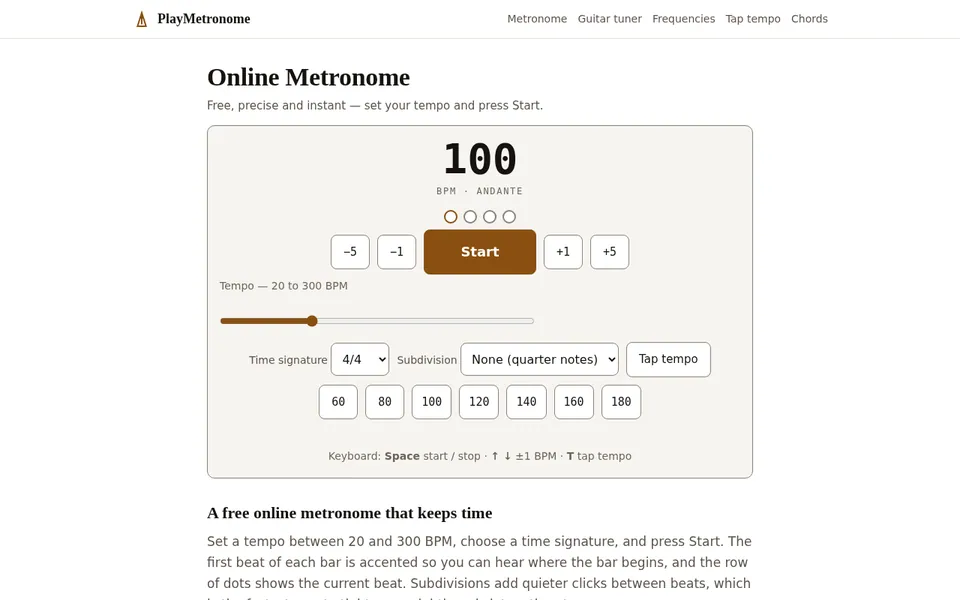
Enter the BPM in the converter. It lists the quarter, eighth, sixteenth, dotted and triplet lengths in ms and Hz. If you only know the tempo by feel, tap it first with the tap tempo tool, then paste the BPM into the converter.
Rounding is fine for most delay work. Many devices accept whole milliseconds, so 666.67 can be entered as 667.
Frequently asked questions
How do I convert milliseconds back to BPM?
Divide 60,000 by the milliseconds of a quarter note. For example, 60,000 / 500 = 120 BPM. If your time is for another note length, convert it to a quarter note first.
What is a dotted eighth note delay at 120 BPM?
It is 375 ms. An eighth note is 250 ms, and a dotted note is 1.5 times that: 250 x 1.5 = 375 ms.
How long is one bar of 4/4 at 120 BPM?
A bar of 4/4 has four quarter notes. At 500 ms each, that is 4 x 500 = 2000 ms, or 2 seconds.